U.S. Constitution, Amendment III, 1791
No Soldier shall, in time of
The same moment, today
A key turns in the front door lock at ten o'clock at night. The bolt slides home with a sharp click, and the sound brings a quiet sense of relief. Inside that room, nobody can tell someone else to move their shoes or give up the sofa. The world outside can be loud and demanding, but the space behind that lock belongs to the person who lives there. When that boundary gets crossed without permission, everything feels unsafe.
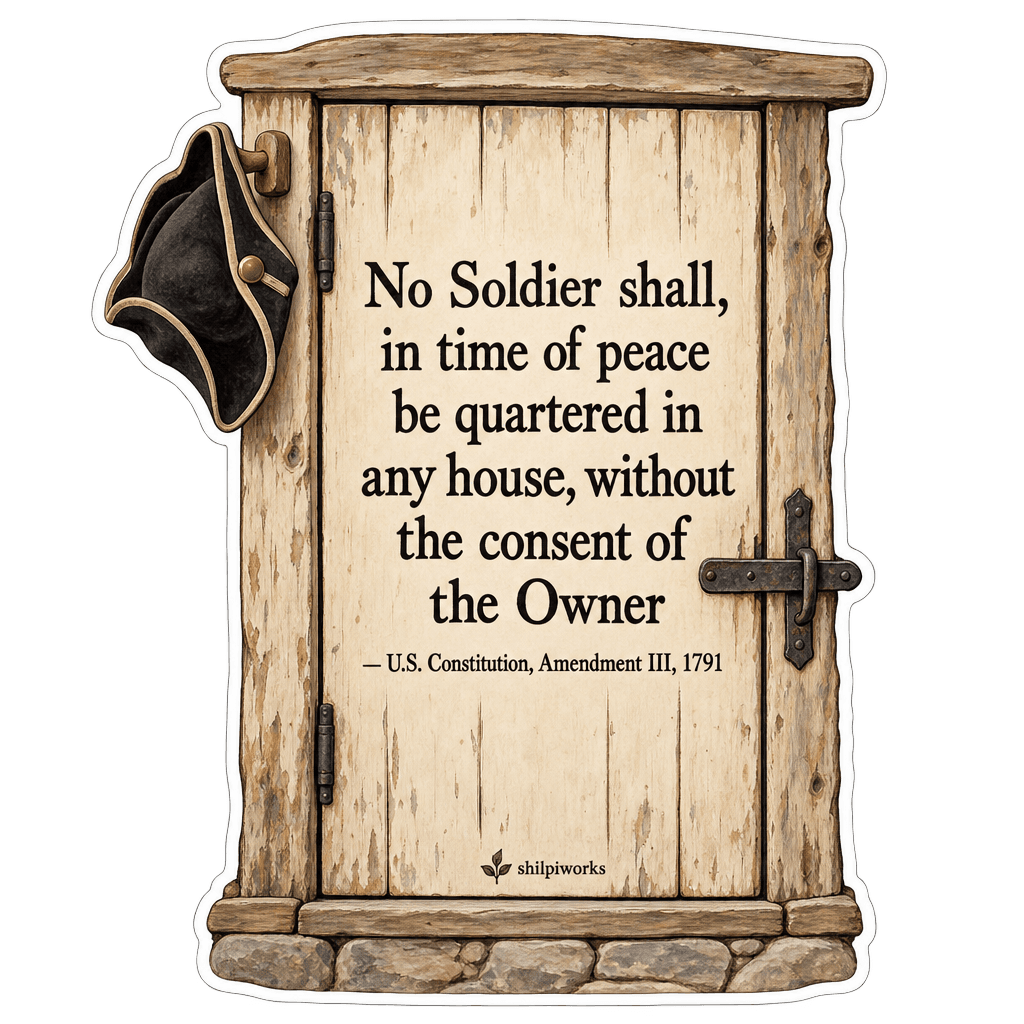
The Third Amendment isn't just about redcoats demanding a bed. It's about drawing a line where the power of the state stops and private life begins. When a government can put its people inside your living room, you don't really own your home anymore. The law protects the quiet corners where you don't have to answer to an authority. Even today, the courts look back at this line when they talk about a person's basic right to privacy.
The lesson
Pay attention when small boundaries slip away in the name of convenience. Once you let someone move in on your quiet spaces, it's very hard to push them back out.
Where this comes from
A grievance written into law
James Madison introduced the proposal at Federal Hall in New York City on June 8, 1789. Colonists were angry about the British Quartering Acts of 1765 and 1774, which forced communities to house royal troops. Congress approved the text that September, and Virginia ratified it on December 15, 1791. It's one of the least argued parts of the Constitution today. Still, judges cite it. In 1965, the Supreme Court used it in Griswold v. Connecticut to show that the home has a zone of privacy. In 1982, correction officers in Engblom v. Carey used it when National Guard troops occupied their state-owned housing.
A home only belongs to you if you get to decide who enters.
$3.50
2.5 inches vinyl · weatherproof · ships in 1–3 days
Mix & save: 3 for $9 · 5 for $14 · 10 for $25· free shipping at ten
- Weatherproof vinyl
- Ships from Wayzata in 1–3 business days
- Secure checkout
If anything is wrong, we'll refund or replace it. Read the policy
The artwork is made with AI image tools, by agents we design and check. Each sticker is then printed on vinyl and die-cut to order.