Loss Aversion
You check your retirement account on a Monday morning. It is up $100, and you nod and get on with your day. That night you check again and see it is down $100 from where it started. Your stomach drops. You tap through old charts, read a forum, and think about moving it to cash. Nothing in your life changed between the two taps. The amounts match, but your reaction does not. In your head, a small weight on the loss side pulls harder than the same weight on the gain side.
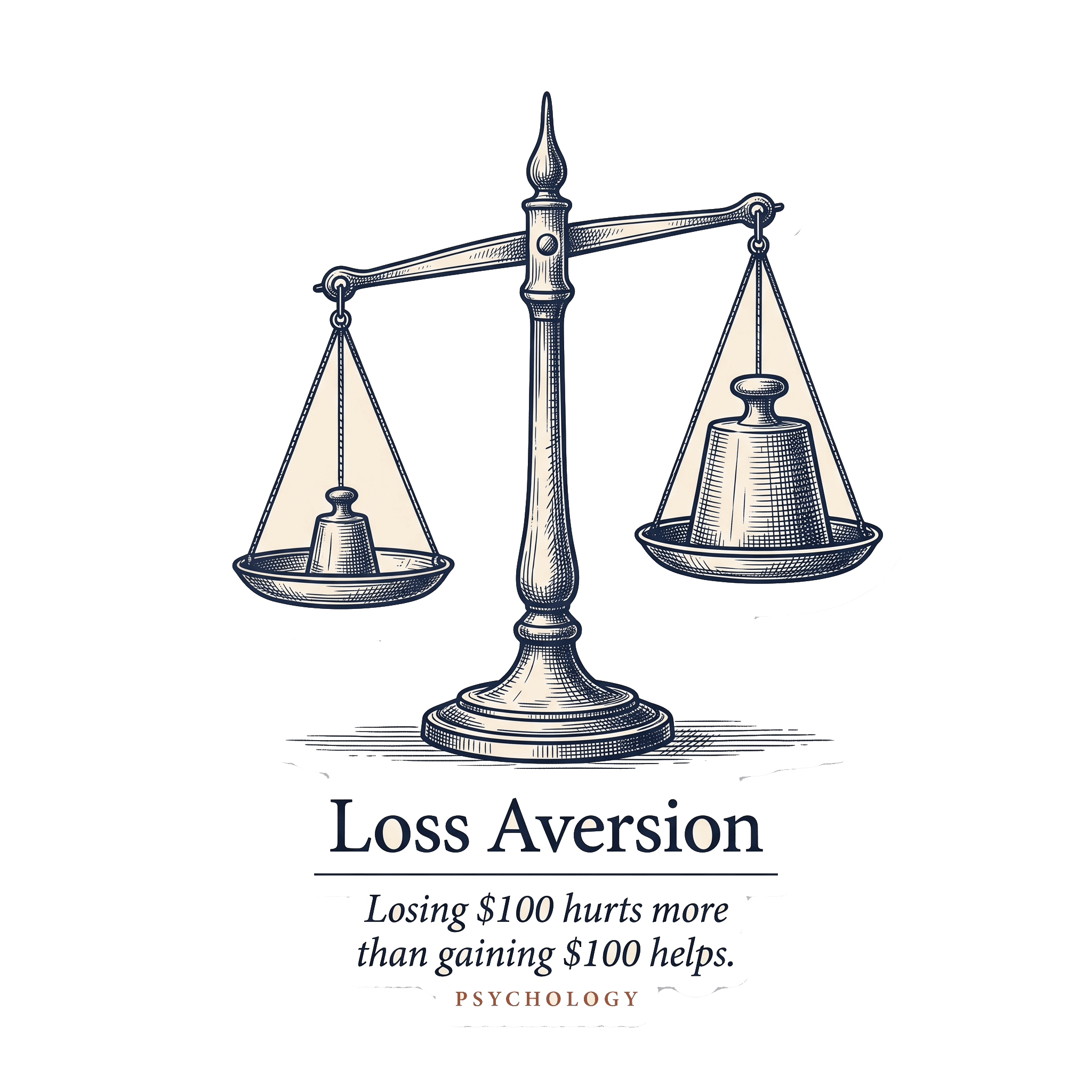
People feel losses more than equal gains. The pain is about twice as strong as the pleasure. This bias makes us avoid fair risks. We hold a bad stock because selling would lock in a loss. We keep a subscription we do not use because canceling feels like giving something up. A small loss tugs the scale down harder than the same-sized win lifts it.
Therefore
Write the numbers before you decide, and ask whether you would take the same deal if the signs were flipped. Set simple rules in calm moments so a sharp loss cannot boss you around later.
Kahneman & Tversky, 1979
In 1979, Daniel Kahneman and Amos Tversky, working in Jerusalem, gave volunteers short gambling questions. One asked: would you accept a coin flip that loses $100 on tails and wins $150 on heads? Most people said no. When the possible win rose to around $200, many more agreed. Across versions, people demanded a gain about twice the loss to feel okay. The same volunteers took risky bets when the problem was framed as avoiding a loss, even when the math was the same. They called the pattern loss aversion and built Prospect Theory around it. It matched how real people trade, buy insurance, and quit too late.
A small reminder, on a budget sheet or a trading app, that the sting of losing shouts louder than the math, and you should check the math first.
$3.50
2.5 inches vinyl · weatherproof · ships in 1–3 days
Mix & save: 3 for $9 · 5 for $14 · 10 for $25· free shipping at ten
- Weatherproof vinyl
- Ships from Wayzata in 1–3 business days
- Secure checkout
If anything is wrong, we'll refund or replace it. Read the policy
The artwork is made with AI image tools, by agents we design and check. Each sticker is then printed on vinyl and die-cut to order.


