William Shakespeare (1864), Part I, Book II, chapter IV, in the A. Baillot translation
What Speech Cannot Carry
In 1863 Victor Hugo lived in exile at Hauteville House on the island of Guernsey. The French emperor had banished him twelve years earlier. In the house, his son François-Victor Hugo worked on a French translation of Shakespeare. The father decided to write a short preface for the project. The preface soon grew into a separate book of three hundred pages. Hugo finished the manuscript in March 1864 to mark three hundred years since Shakespeare was born. He was thinking about how people speak under tyranny.
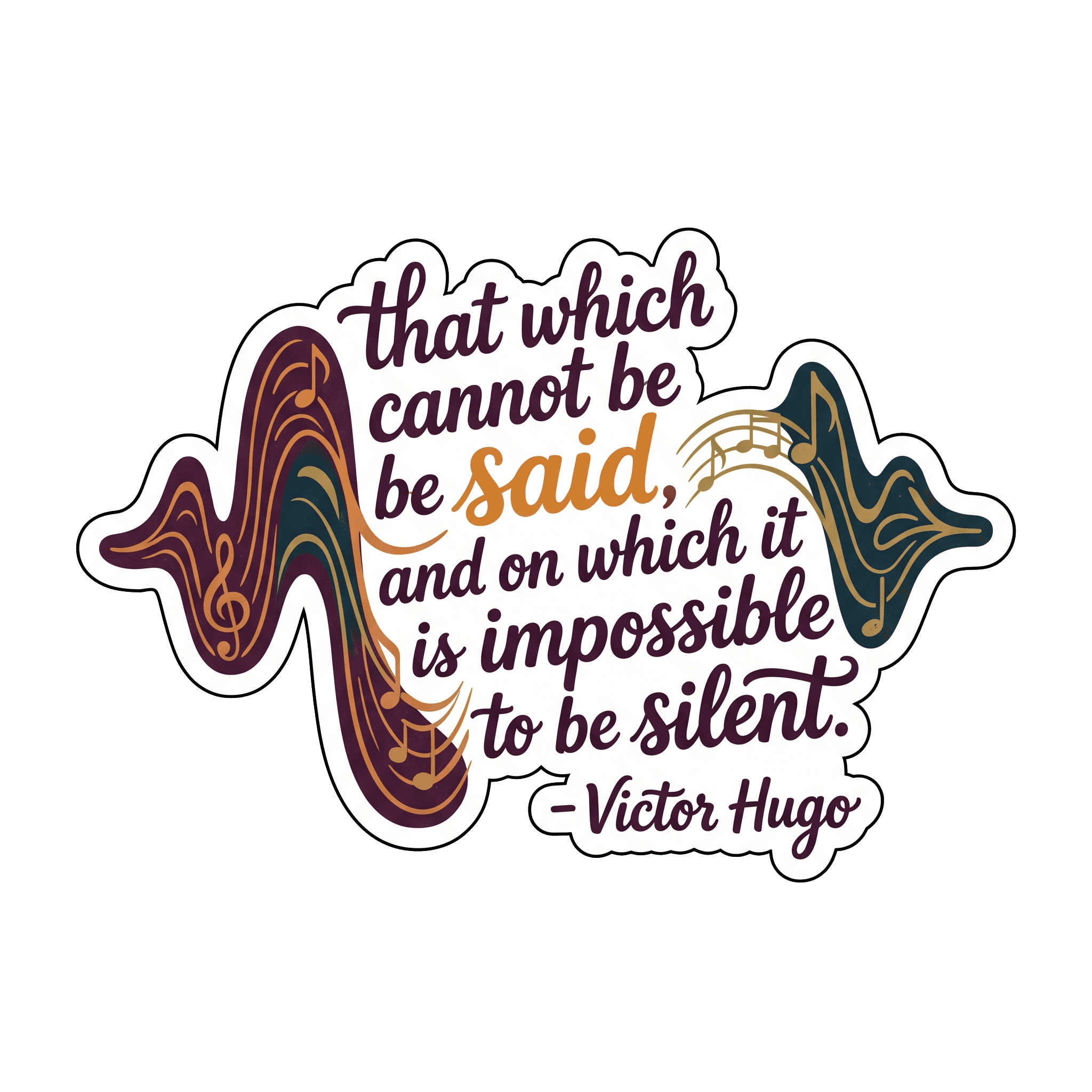
People often assume Hugo was writing a gentle compliment about feelings. He was not. In Part I, Book II, chapter IV of William Shakespeare, in the A. Baillot translation, he was analyzing German politics. German citizens lived under tight police control, and the state silenced their speech. Hugo argued that the public turned to music because rulers could not censor a melody. He wrote: "Music expresses that which cannot be said, and on which it is impossible to be silent." When you cannot speak safely, you do not simply keep quiet. A song takes the weight that speech had to drop.
Therefore
When a feeling is too heavy for plain words, stop trying to phrase it. Put on a record and let the sound do the work.
Saint Peter Port, 1864
Publishers issued William Shakespeare in Brussels, Paris, and London in April 1864. In chapter four, Hugo pointed straight at German singing clubs and church choirs. He compared a hymn by Martin Luther to the French Marseillaise. A choir allowed hundreds of citizens to share an urge for freedom without printing a single forbidden sentence. The police could ban an article, but they could not arrest an entire town for humming together. Hugo knew this because he watched it from exile across the English Channel. Sound carried what printer ink could not risk.
A small reminder, on the desk or the speaker, that some things are too heavy for speech and need music instead.
$3.50
2.5 inches vinyl · weatherproof · ships in 1–3 days
Mix & save: 3 for $9 · 5 for $14 · 10 for $25· free shipping at ten
- Weatherproof vinyl
- Ships from Wayzata in 1–3 business days
- Secure checkout
If anything is wrong, we'll refund or replace it. Read the policy
Related patterns
pairs with
Nietzsche Music and Life Quote
Nietzsche also saw music as an escape from the weight of ordinary existence.

contrasts with
Charlie Parker Vinyl Sun
Parker rooted music in lived human experience rather than what words cannot say.
extends to
Beethoven's Creative Calling Quote
Beethoven used composition to voice what his failing ears kept from daily speech.