Clinging Is Possession
The story
The seventh chapter of the Tattvartha Sutra defines the five things a Jain vows to give up: violence, lying, stealing, unchastity and possession. The first four get fuller definitions. Possession gets two words, and they move it from the object to the mind. The Sarvarthasiddhi explains that the clinging is the work of guarding, getting and tending things, whether they are cows and gems or attachments inside.
मूर्च्छा परिग्रहः
mūrcchā parigrahaḥ
Tattvārtha Sūtra 7.17 in the Digambara recension, 7.12 in the Śvetāmbara; our translation
The same moment, today
A man pays fifty dollars every month for a storage unit across town. Inside, there are four cardboard boxes, an old wooden desk, and a broken lamp. He hasn't opened the padlock in two years. He doesn't actually need anything in there, but he can't bring himself to cancel the lease. Throwing those old things away makes him anxious, so he keeps paying. The boxes don't hold him. He's holding them.
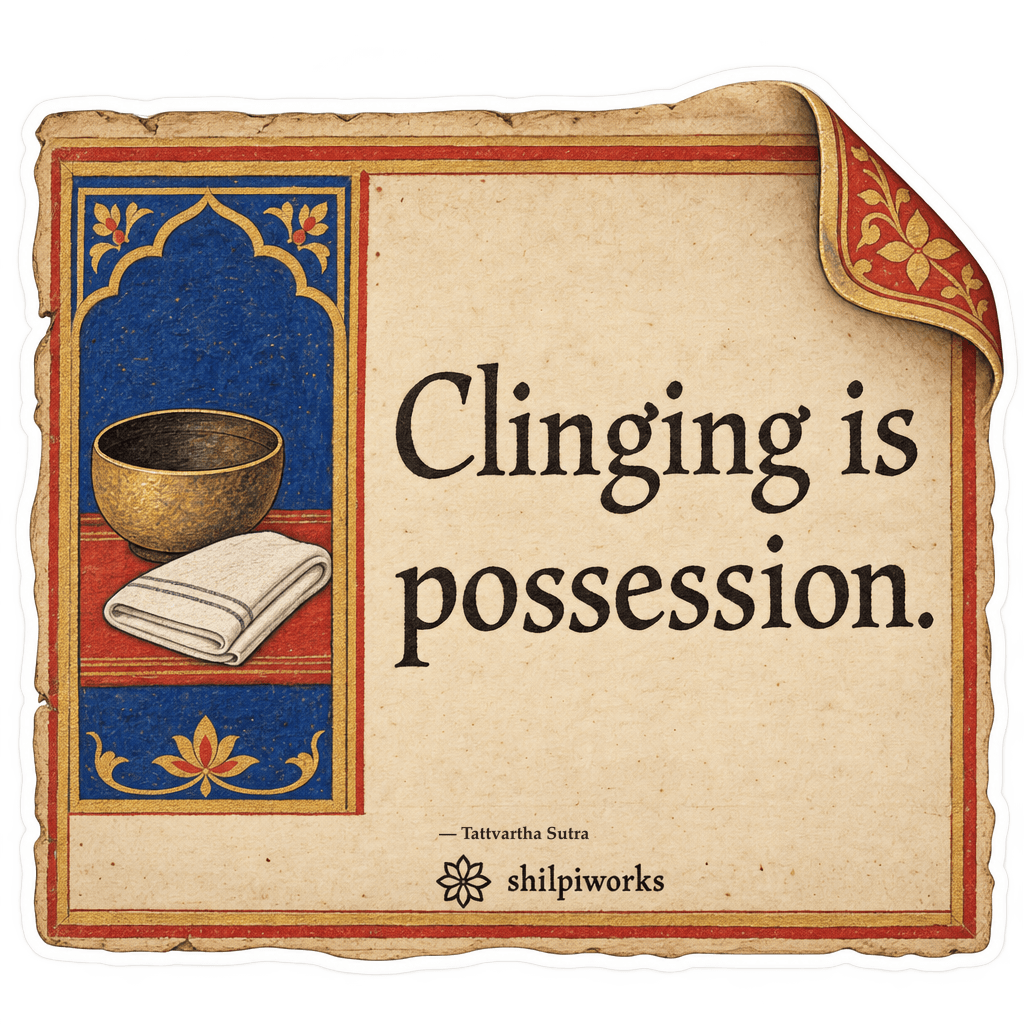
The Tattvartha Sutra defines possession as clinging, not as the physical stuff you own. The problem isn't the object itself, but the tight mental grip you have on it. Jains call this aparigraha, the vow to drop possessiveness. That definition explains why monks live the way they do. Digambara monks don't own a single thing, not even clothes. Svetambara monks keep only a few tools like robes, a bowl, and a small whisk broom to sweep away bugs before sitting, because using those simple items doesn't mean clinging to them.
The lesson
Take a look at something you're afraid to lose. Notice whether you're taking care of it, or if it's taking up space in your head.
Where this comes from
Pujyapada, 6th Century
The Tattvartha Sutra was composed by Umasvati between the second and fifth centuries. It's the one doctrine book accepted as scripture by both Svetambara and Digambara Jains. In the sixth century, the Digambara teacher Pujyapada wrote an important commentary on it called the Sarvarthasiddhi. He explained that clinging isn't just about owning cows, buffaloes, or pearls. It's the daily worry of getting them, guarding them, and fretting over them. It's also the internal anger and pride you refuse to drop. The line here is a plain rendering of the Sanskrit original, not a quote from a published translation.
A small reminder, on your laptop or notebook, that you don't really own what you have to worry about keeping.
$3.50
2.5 inches vinyl · weatherproof · ships in 1–3 days
Mix & save: 3 for $9 · 5 for $14 · 10 for $25· free shipping at ten
- Weatherproof vinyl
- Ships from Wayzata in 1–3 business days
- Secure checkout
If anything is wrong, we'll refund or replace it. Read the policy